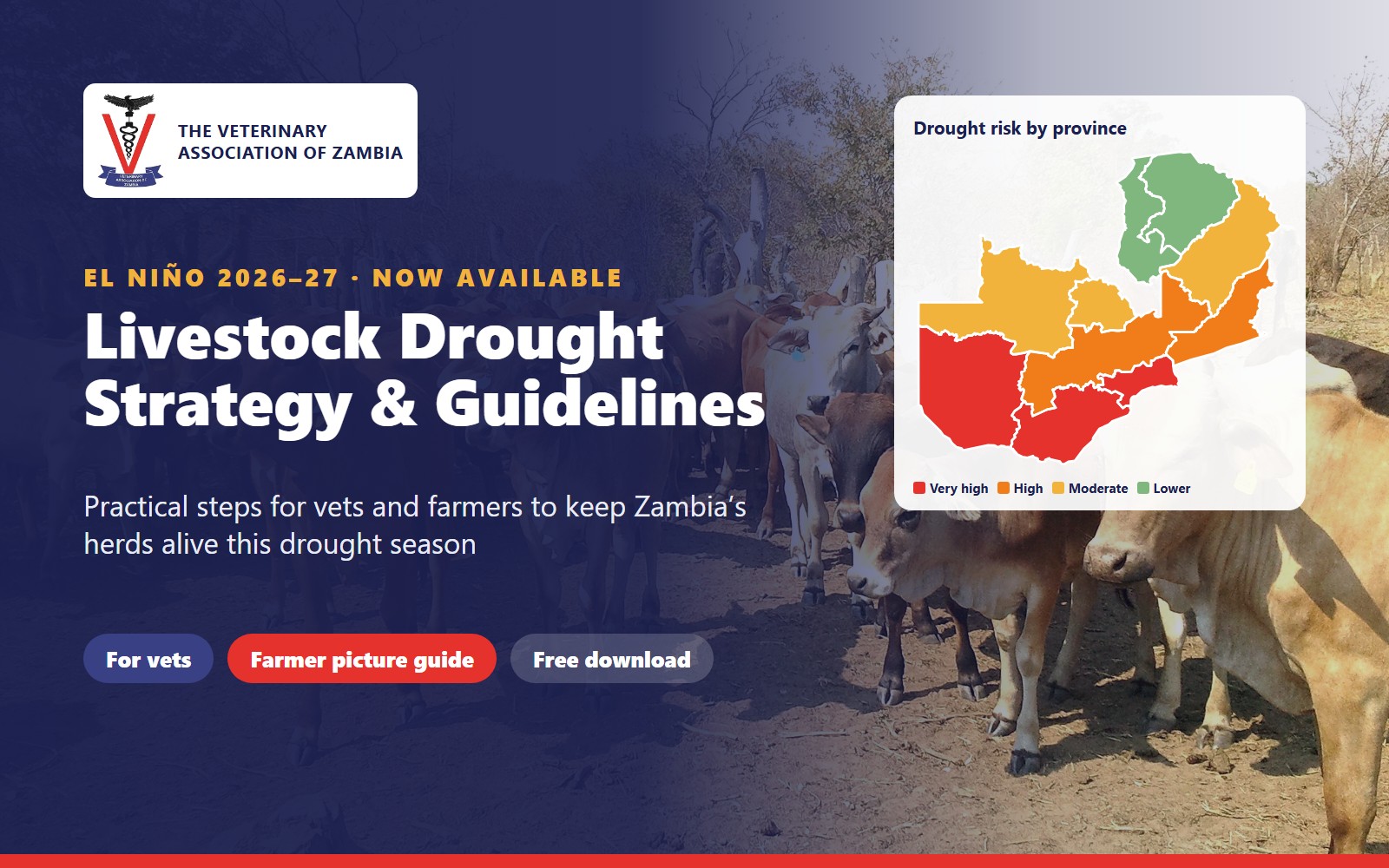
El Niño 2026–27 · Livestock advisory
Protect your herd this El Niño season: VAZ launches its Livestock Drought Strategy 2026–2027
Practical guidelines for veterinary professionals and a picture guide for small-scale farmers, free to download.
Zambia has entered the hottest months of the year as one of the strongest El Niño events in recent memory takes hold. The regional climate outlook (SARCOF-33, August 2026) points to below-normal rainfall over southern Zambia for the whole season, and over most of the country from January to March 2027. Government has asked every province to activate its contingency plans.
The Veterinary Association of Zambia (VAZ) has therefore published the El Niño Livestock Drought Strategy & Guidelines 2026–2027. It turns the science of drought management into steps that farmers and veterinary teams can act on now, before animals lose condition.
Where the risk is highest
Risk tiers based on the SARCOF-33 seasonal outlook. The full strategy includes a detailed risk map.
Five messages that keep animals alive
- Plan early for feed and water. Count grazing, crop residues, hay and water now. Do not burn crop residues.
- Check body condition. Score every animal monthly on a 1–5 scale; keep breeding cows at 2.5 or above.
- Group animals by need. Cows with calves and heavily pregnant cows need the most feed; dry cows the least.
- Protect the core breeding herd. Keep pregnant cows and heifers. Sell bulls, old and non-pregnant animals early, while prices hold.
- Work with your vet. Vaccinate before the rains, deworm, dip weekly, use urea only with training, and report sudden deaths.
Act on triggers, not on hope
The strategy follows the drought-cycle approach of the international Livestock Emergency Guidelines and Standards (LEGS). As of October 2026, the South and West are at Alert and may move to Alarm from December if the early rains fail.
What is inside
- Roles of the farmer–vet–nutritionist team
- Nutritional requirement tables and a worked feed budget
- Supplementation decision tree and urea safety
- Herd-reduction order, early weaning, relocation audit
- Health calendar, parasite control, sudden-death and anthrax response
- Monitoring indicators and a monthly herd sheet
- Ten golden rules for the dry season
- Is my animal too thin? Body condition in pictures
- Group your herd; count your feed and water
- Keep or sell? Six checks before moving animals
- Protect your animals from disease
- When the rains return
Download free · print and share at dip tanks, camps, markets and cooperative meetings.
Full Strategy & Guidelines (PDF, 28 pp) Farmer Picture Guide (PDF, 8 pp)VAZ thanks the authors, Dr Moosa Ameen (Agrivet Africa) and Dr Henry Ndandalika (Veterinary Consultant), and the editors, Dr Ruth L. Mfune and Dr Eugene Chisela Bwalya. Members are asked to carry this guidance to the farmers in their districts. Farmers should contact their nearest District Veterinary Office or veterinary camp officer for advice specific to their area and animals.
Issued by the Veterinary Association of Zambia · Kwacha House, Cairo Road, Lusaka · info@vaz.org.zm · +260 211 238720