Home › News › Article

Call for abstracts is open: Present your work at VAZ 2027 Scientific Conference

Back to News Call for abstracts is open: Present your work at VAZ 2027 Scientific Conference

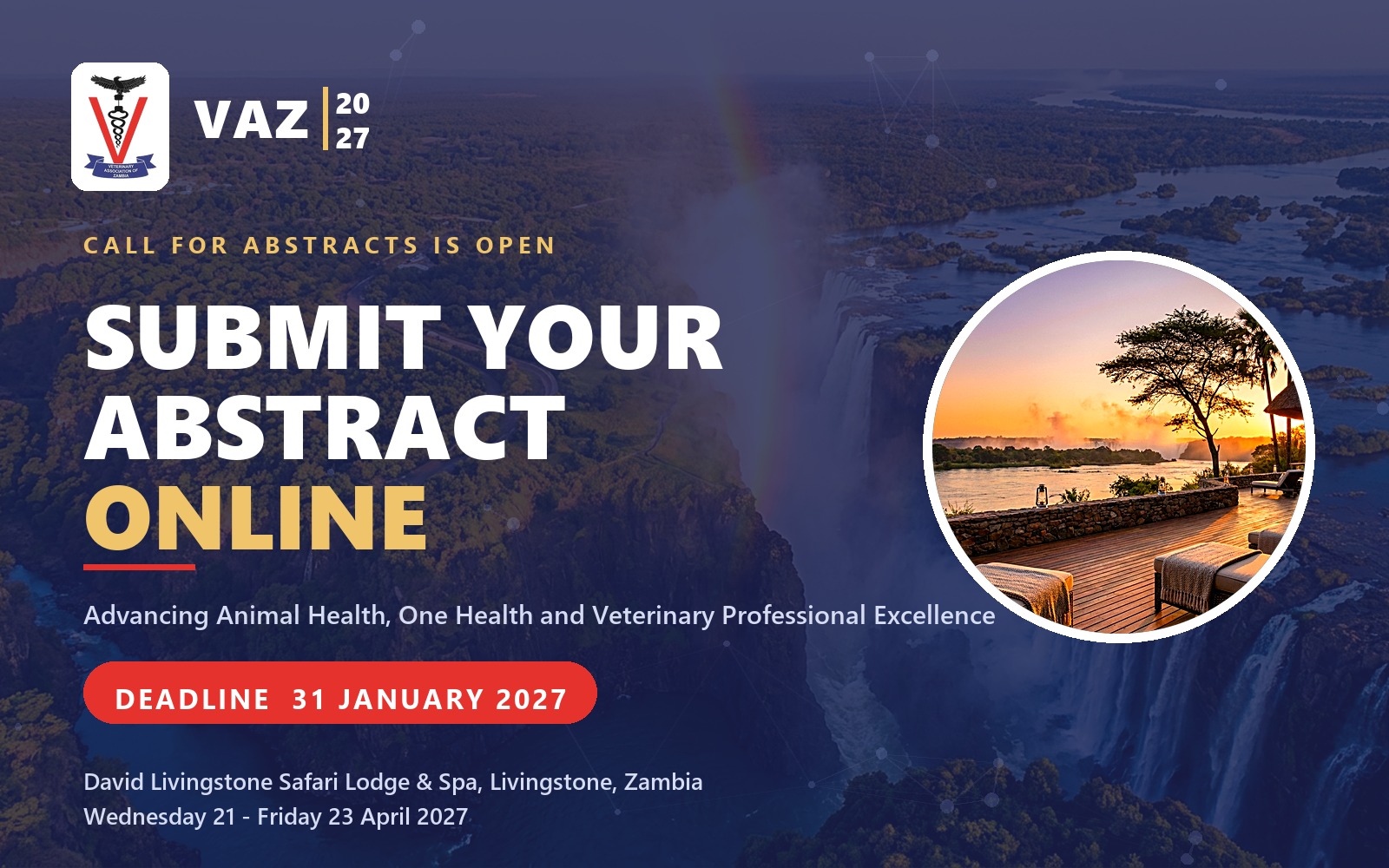
Call for abstracts is open

Present your work at VAZ 2027

Advancing Animal Health, One Health and Veterinary Professional Excellence
David Livingstone Safari Lodge & Spa, Livingstone, Zambia
Wednesday 21 - Friday 23 April 2027. Scientific sessions 21 - 22 April; Annual General Meeting 23 April

Submissions close in

--Days
--Hours
--Mins
--Secs

Deadline Sunday, 31 January 2027, 23:59 CAT

Submit your abstract

The Veterinary Association of Zambia invites the submission of abstracts for the 2027 VAZ Scientific Conference and Annual General Meeting, to be held from 21 to 23 April 2027 at the David Livingstone Safari Lodge & Spa in Livingstone, on the banks of the Zambezi and within sight of Mosi-oa-Tunya, the Smoke that Thunders.

Under the theme "Advancing Animal Health, One Health and Veterinary Professional Excellence", VAZ 2027 convenes veterinarians, veterinary para-professionals, researchers, students, regulators, policymakers, industry and development partners from Zambia, the SADC region and beyond. The conference closes on the eve of World Veterinary Day, Saturday 24 April 2027.

Whether you are reporting original research, a field or outbreak investigation, a clinical case series, an implementation programme, a laboratory innovation or a policy analysis, this is the platform where your evidence reaches the people who can act on it. Established scientists, early-career professionals and students are all welcome.

Submission is entirely online, on this page. There is no form to download and nothing to email. Scroll down, fill in the form, and your VAZ reference number arrives by email the moment you submit. It works on a phone, and you do not need a Google account.

Why present at VAZ 2027

ReachThe people who act on evidence
PublishIn the VAZ Book of Abstracts
EarnRecognised CPD credits
CompeteFor the VAZ Awards

Four thematic areas

The lists are indicative. Work that cuts across areas is welcome: give a first and a second preference.

TA1One Health in Action: Zoonoses, Antimicrobial Resistance and Food SafetyZoonotic disease surveillance, outbreak investigation and response; anthrax, brucellosis, bovine tuberculosis, Rift Valley fever and emerging zoonoses; antimicrobial use, resistance and stewardship across the animal health value chain; food safety, meat inspection, hygiene and chemical residues; the human-livestock-wildlife-environment interface; multisectoral coordination, One Health governance and joint risk assessment.
TA2Rabies: Diagnosis, Surveillance and the Challenge of Elimination in ZambiaLaboratory diagnosis and diagnostic capacity (dFAT, DRIT, lateral flow devices, RT-PCR and sequencing) and the sample referral pathways that feed them; case detection, under-reporting and integrated bite-case management; dog demography, dog population management and mass vaccination coverage; vaccine supply, cold chain and sustainable financing; access to post-exposure prophylaxis; wildlife rabies and the domestic-wildlife interface; community engagement and responsible dog ownership; and the operational, economic and political barriers to eliminating dog-mediated human rabies in Zambia by 2030.
TA3Innovation, Diagnostics and the Digital Transformation of Veterinary PracticeNew and field-deployable diagnostics; laboratory quality management systems and accreditation to ISO 15189 and ISO/IEC 17025; digital disease surveillance and early-warning systems; telemedicine and mobile veterinary services; practice management systems and clinical record-keeping; data science and artificial intelligence in animal health; clinical case management, imaging and therapeutic advances; and veterinary education, CPD delivery and specialisation pathways.
TA4Sustainable Livestock, Aquaculture and Animal WelfareLivestock productivity, nutrition and herd or flock health programmes; on-farm biosecurity; aquaculture and fish health; wildlife health and conservation medicine; animal welfare standards and humane handling, transport and slaughter; climate resilience, rangeland and grazing management; trade, market access and sanitary compliance; and the economics of animal health, veterinary entrepreneurship and practice sustainability.

Presentation formats

Oral presentation10 minutes of presentation followed by 3 minutes of discussion
Poster presentationA0 portrait (841 x 1189 mm)
RapidA 3-minute flash presentation to the plenary

Indicate your preferred format when you submit. The VAZ Abstracts Committee determines the final format for each accepted abstract and its decision is final.

What your abstract must contain

Structure. Five headings, in order: Background, Objectives, Methods, Results, Conclusion.

Length. Maximum 300 words across those five sections. The title is a maximum of 20 words.

Keywords. 3 to 6, in alphabetical order.

Style. English only. No tables, figures, references or footnotes. Report actual results; abstracts saying "results will be presented" are not accepted.

Ethics. Where animals or human participants were involved, state the approval number and the issuing committee.

How your abstract is assessed

Abstracts are peer-reviewed by the VAZ Abstracts Committee against five criteria: relevance to the theme and the chosen thematic area; scientific quality and methodological soundness; originality and innovation; clarity and completeness of reporting; and applicability to animal health and livestock development in Zambia. The Committee's decision is final.

Acceptance is conditional on registration. The presenting author must register and pay the conference fee by Tuesday, 30 March 2027. Abstracts whose presenting author has not registered by that date are withdrawn from the programme and from the Book of Abstracts. Register for VAZ 2027.

Key dates

Call for abstracts opensMonday, 23 November 2026
Abstract submission deadlineSunday, 31 January 2027, 23:59 CAT
Notification of acceptanceFriday, 26 February 2027
Presenting author registration deadlineTuesday, 30 March 2027
Final presentation files and poster proofs dueFriday, 9 April 2027
Scientific sessionsWednesday 21 - Thursday 22 April 2027
Annual General MeetingFriday, 23 April 2027
World Veterinary DaySaturday, 24 April 2027

Submit your abstract

Before you start. Have your abstract ready, written to the guidelines above. You will paste it in step 3, under the five headings. It takes about ten minutes, works on a phone, and you do not need a Google account or an email client.
Deadline31 January 2027
Body limit300 words
Decision by26 February 2027
1

Presenting author

The person who will attend and present. These details are used only for the conference.

Surname last. Used in the file name of your abstract.
As you would like them published, e.g. BVM, MSc.
Your reference number and the decision are sent here.
Include the country code.
Students are eligible for the Best Student Presentation award.
If you are not a member, type: Not applicable.
2

The abstract

Maximum 20 words, sentence case, no abbreviations.

Title: 0 of 20 words

Full names and initials, comma separated, in publication order. Mark the presenting author with an asterisk *.
One per line, numbered: 1 Department, Institution, City, Country.
The VAZ Abstracts Committee sets the final format and its decision is final.
3

Structured abstract

Maximum 300 words across the five sections together. No tables, figures or references. Report actual results; abstracts saying "results will be presented" are not accepted.

Body: 0 of 300 words

Why the work matters, and the gap it addresses.
What you set out to determine.
Design, setting, period, population, analysis.
The actual findings, with numbers.
What the findings mean, and what should follow.
4

Keywords and declarations

3 to 6 keywords, alphabetical, separated by semicolons.
Where animals or human participants were involved, give the approval number and issuing committee. Otherwise type: Not applicable.
5

Attach your file (optional)

If you wrote your abstract in the VAZ 2027 Abstract Template, attach it here as a Word .docx file, up to 10 MB. This is optional: the text you typed above is your submission. The file helps us keep your italics and superscripts for the Book of Abstracts.
6

Confirm and submit

Having trouble? Email your abstract to events@vaz.org.zm and the Secretariat will enter it for you.

Contact

Abstracts and scientific programme: events@vaz.org.zm
Secretariat: admin@vaz.org.zm | secretary@vaz.org.zm
Telephone: +260 211 238720 | +260 95 4170130
Website: member.vaz.org.zm

Issued by the Veterinary Association of Zambia | Approved by the VAZ Events Committee
WelcomeVAZ & VCZVeterinary Association of Zambia and Veterinary Council of Zambia member portal
VerifycertificateEvents& CPDNews& noticesRegisteror renewPayfeesFAQget helpCPDtrainingDocumentsAboutus
VAZ
You are offline. Showing pages saved on this device.