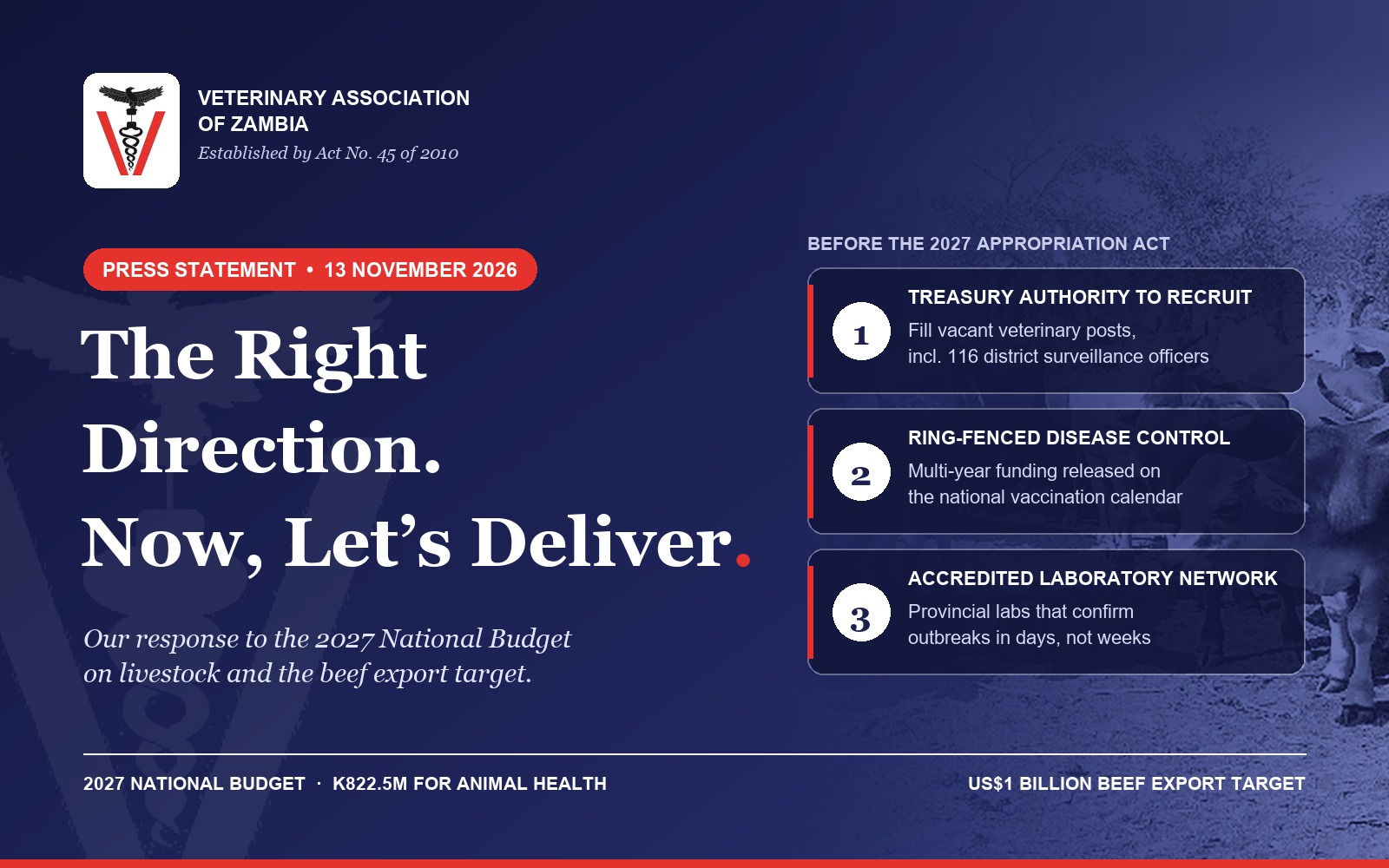
The Association backs the USD 1 billion beef export target and urges three measures before the 2027 Appropriation Act is passed: recruitment, ring-fenced disease control funding and an accredited laboratory network.
The Veterinary Association of Zambia (VAZ) welcomes the 2027 National Budget presented to the National Assembly on 6 November 2026 by the Minister of Finance and National Planning, Hon. Dr Situmbeko Musokotwane, MP. The Budget places livestock firmly at the heart of the Grow Zambia Agenda. We commend Government for this clear direction.
The Association particularly welcomes three decisions. Disease control through vaccination and surveillance is the first measure under the USD 1 billion beef export target. Animal Health Services now has a dedicated allocation of K822.5 million. In addition, K100 million has been set aside to establish beef compartments.
A bold target deserves a strong veterinary service
Zambia aims to grow its national cattle herd to 7.5 million by 2027 and 11 million by 2031. The Association believes these targets are achievable. They will not, however, be met by funding alone. They require veterinarians and para-professionals on the ground, and laboratories that work.
On the current path, the herd will reach about 5.9 million in 2027 and 6.7 million in 2031. Closing that gap depends on more calves being born and fewer animals being lost. Both are veterinary outcomes.
What the Association has observed
- Staffing. The Ministry’s own Revised Sector Devolution Plan records 874 veterinary staff in post at district level against 1,212 required. That leaves 338 posts vacant, with only 90 District Veterinary Officers for 116 districts. District livestock development staff are at 40 percent of requirement.
- Funding. Animal Health Services receives 0.29 percent of the Budget. Its share of the agriculture, fisheries and livestock allocation has declined since 2026, even as that allocation grew by 46 percent.
- Laboratories. Government has rehabilitated provincial laboratories in Chipata, Choma, Isoka and Kasama. The next step is to fund reagents, sample transport, staff and accreditation, so that outbreaks are confirmed in days, not weeks.
The outbreaks of 2026, including Foot-and-Mouth Disease, Contagious Bovine Pleuropneumonia and anthrax, remind us what is at stake. Trading partners buy confidence before they buy beef.
Government has shown the way
The 2027 Budget itself shows what focused investment can achieve. Government has recruited 41,917 teachers since 2022 and 21,500 health workers over the past five years. It will recruit a further 3,125 frontline medical personnel in 2027. It has also more than doubled funding for mines standards and regulation, because mineral exports depend on it.
The veterinary service plays the same role for beef exports. The Ministry’s own Sector Devolution Plan already recommends that Treasury authority to recruit be granted expeditiously. The Association is confident that the same priority can be extended to the veterinary service, within the wage bill ceiling.
Our three priority requests
The Association respectfully urges Government to consider three measures before the 2027 Appropriation Act is passed:
- Treasury Authority to recruit. Fill vacant veterinary posts in phases by 2029, beginning in 2027 with frontline and laboratory officers, including 10 provincial and 116 district surveillance officers.
- Ring-fenced disease control funding. A multi-year allocation for vaccination and surveillance, released in line with the national vaccination calendar.
- An accredited laboratory network. A dedicated budget line for the provincial veterinary laboratories, covering reagents, sample transport and international accreditation.
These measures are modest when set against the USD 1 billion a year they are intended to protect.
Working together
The Association has submitted a detailed position paper to the Honourable Minister of Finance and National Planning, setting out eight recommendations in order of priority. We have offered to work with the Treasury and the Ministry of Fisheries and Livestock on their costing and phasing.
We look forward to working closely with the Minister of Fisheries and Livestock, Hon. Olive C. Chiboola, MP, and her Ministry. Our members stand ready to play their part.
About VAZ. The Veterinary Association of Zambia is the professional body for veterinarians and veterinary para-professionals in Zambia, established under the Veterinary and Veterinary Para-Professions Act No. 45 of 2010, which mandates it to advise Government on matters relating to the profession.
Sources. 2027 Budget Speech (6 November 2026); The 2023 Livestock Survey Report; Ministry of Fisheries and Livestock, Revised Sector Devolution Plan (2026), Tables 3.1 and 3.2 (district-level staffing).
Issued by Dr Eugene C. Bwalya, President, Veterinary Association of Zambia
Media enquiries: admin@vaz.org.zm | +260 211 238720 | +260 954 170130 | www.vaz.org.zm