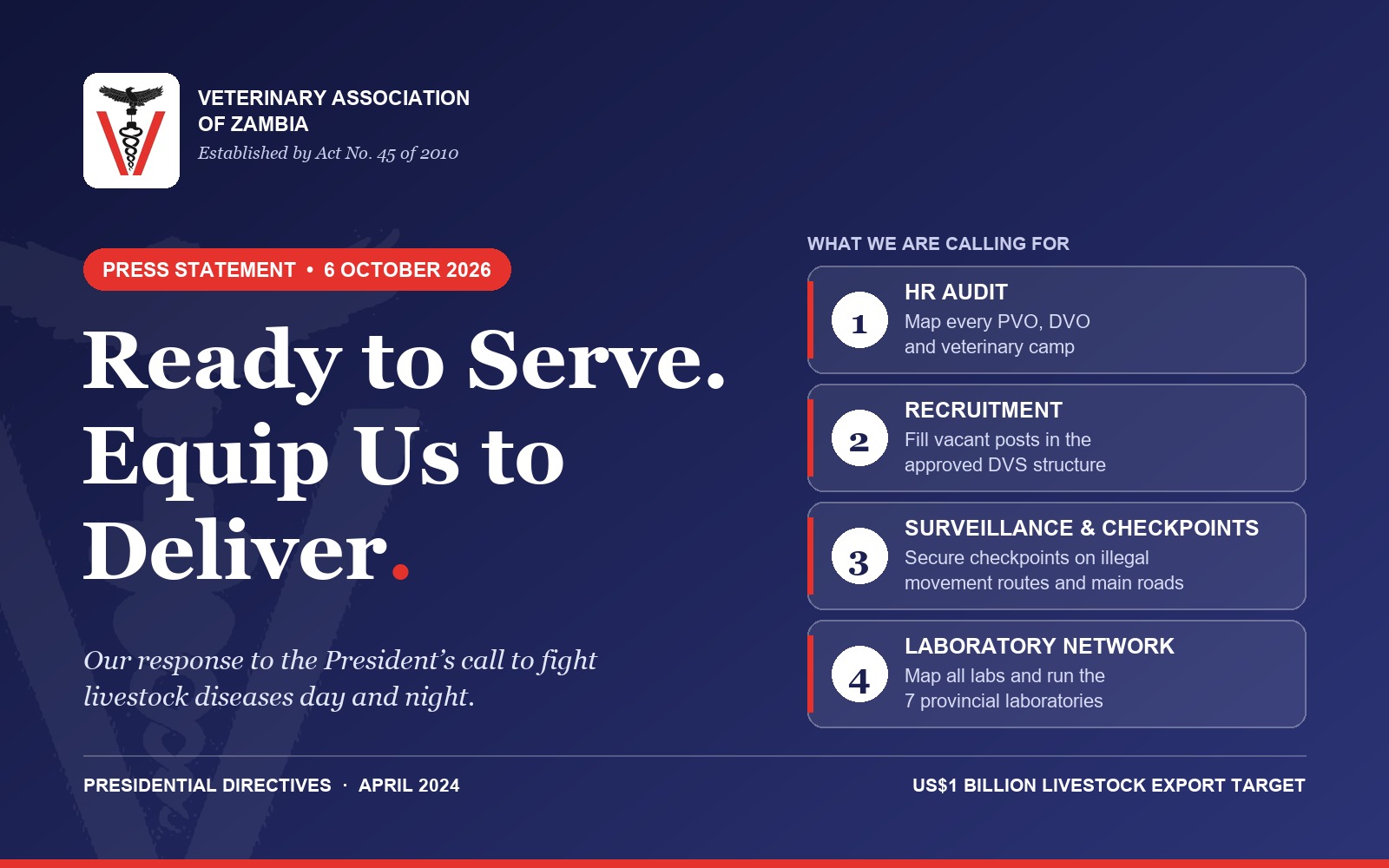
A call for a veterinary human resource audit, recruitment, heightened surveillance with secure livestock checkpoints, and a fully functional laboratory network, in line with the Presidential Directives of April 2024.
The Veterinary Association of Zambia (VAZ) has received media enquiries on the remarks made by the President of the Republic of Zambia, His Excellency Mr Hakainde Hichilema, at the Samu Lya Moomba Traditional Ceremony of Chief Choongo in Bweengwa, Monze District, on 4 October 2026. As widely reported, the President urged the veterinary department to “stop sleeping” and to work day and night against livestock diseases, so as to protect the national target of earning US$1 billion a year from livestock exports.
At the outset, the Association once again extends its warm congratulations to His Excellency on his re-election, and welcomes his personal attention to animal health. We share his sense of urgency. The US$1 billion beef export target under the 10-10-5-3-3-1-1-1 Grow Zambia Agenda has the Association’s full support, and it rests first on the control of animal diseases.
Where the Association stands
As a body established under the Veterinary and Veterinary Para-Professions Act No. 45 of 2010, the Association is mandated to advise Government on matters relating to the veterinary profession, and to represent, protect and assist veterinary surgeons and para-professionals with regard to their conditions of practice. We respond in exercise of both duties.
The Association is closely following the current disease situation: Foot and Mouth Disease (FMD) movement restrictions in parts of Western and Southern Provinces, including Monze, Namwala and Choma; Contagious Bovine Pleuropneumonia (CBPP) in Namwala District; and anthrax in wildlife and in people in Muchinga Province. Anthrax reminds us that animal health is public health. Some affected areas, notably Namwala, host the disease-free compartments on which the beef export target depends, and trading partners buy confidence before they buy beef. We remain in close contact with the Department of Veterinary Services.
Our members are awake to the task
We assure His Excellency and the nation that our members in the public service are not sleeping. Veterinarians and veterinary para-professionals continue, day in and day out, to vaccinate, treat, inspect, investigate outbreaks, enforce movement controls and work with traditional leaders and farmers, often under harsh and demanding conditions in both remote and urban areas, and frequently beyond normal working hours.
What the public sees as slowness is, in our professional view, largely structural: a few officers covering many animals across very large districts, veterinary camps without a resident officer, limited transport and operational funds, allowance structures that do not support night operations, and diagnostic capacity that is not yet evenly spread across the country.
The Presidential Directives of April 2024
When His Excellency officiated as Guest of Honour at the 80th VAZ Scientific Conference and Annual General Meeting in Livingstone in April 2024, he issued directives on the development of the livestock sector and the welfare of the profession. The Association responded with a Proposed Action Plan in April 2025, covering the elevation of the Central Veterinary Research Institute (CVRI), the National Livestock Epidemiology and Information Centre and the Veterinary Public Health Unit to directorate level with a presence down to district level, improved conditions of service, and the filling of vacant positions.
We acknowledge with appreciation the progress made since, including the job evaluation exercise commenced in 2026, the effort to establish a Veterinary Medicines Directorate at the Zambia Medicines Regulatory Authority, the rehabilitation of provincial veterinary laboratories in Chipata, Choma, Isoka and Kasama, and the establishment of disease-free cattle compartments. However, as recorded at our 81st and 82nd AGMs, key directives on staffing, conditions of service and laboratory capacity remain outstanding. We therefore respectfully appeal for:
- A national veterinary human resource audit. Conducted in the Ministry of Fisheries and Livestock with the Association and the Veterinary Council of Zambia, mapping every Provincial Veterinary Office, District Veterinary Office and veterinary camp to determine staffing levels, skills and deployment gaps, and the transport, cold-chain and diagnostic resources available. The staff establishment should then be realigned with operational demands on the ground, and the veterinary chain of command required by World Organisation for Animal Health (WOAH) standards confirmed for devolved staff.
- Treasury authority to recruit. Filling vacant positions in the approved structure of the Department of Veterinary Services, with priority to camps without officers, high-risk border districts, the disease-free compartments and beef export supply areas, and deploying officers already trained in applied veterinary epidemiology where the risk is greatest.
- Heightened disease surveillance and secure livestock checkpoints. At least one surveillance officer in every province and district, and high-security checkpoints, manned day and night, on the known routes of illegal animal movement, at border crossings and on the main transport roads, working with the Zambia Police and other security wings, local authorities and traditional leaders, and supported by vehicle disinfection, digital movement permits and community sensitisation.
- A fully functional laboratory network. A national mapping of public, private and university veterinary laboratories, and full operationalisation of the provincial laboratories in Chipata, Choma, Isoka, Kasama, Mongu, Ndola and Solwezi, with qualified staff, reliable power, reagents, rapid district-level testing and a path to ISO/IEC 17025 accreditation, so that outbreaks are confirmed quickly and trading partners trust Zambian results.
A request to meet the President
The hot, dry months ahead carry the greatest risk of anthrax, and the coming rains will test every movement control in place against FMD and CBPP. Some of the decisions now needed, such as Treasury authority to recruit, rest with the highest office in the land. The Association therefore respectfully requests an audience with His Excellency the President, at his earliest convenience, together with the Honourable Minister and the Permanent Secretary of Fisheries and Livestock, to report on the directives he himself issued and to agree practical steps, to which the Association stands ready to contribute its expertise.
Notes to Editors. VAZ is the professional body for veterinarians and veterinary para-professionals in Zambia, established under Act No. 45 of 2010.
Issued by Dr Eugene C. Bwalya, President, Veterinary Association of Zambia
Media enquiries: admin@vaz.org.zm | +260 211 238720 | +260 954 170130 | www.vaz.org.zm