World Rabies Day 2026 • Field Report
With a single US$8,000 gift, indunas carrying the message village to village, church pulpits and a real-time digital tracker, Mwandi District has shown what “Stronger Together” looks like on the ground.
Report by Prof Chisoni Mumba, School of Veterinary Medicine, University of Zambia | Mwandi, Western Province | 30 September 2026
The 2026 World Rabies Day theme, “Stronger Together,” has been put into practice in Mwandi District of Western Province. A highly collaborative rabies prevention campaign brought together government institutions, health professionals, veterinary personnel, community organisations, traditional leaders, animal welfare organisations, veterinary professional bodies and local communities.
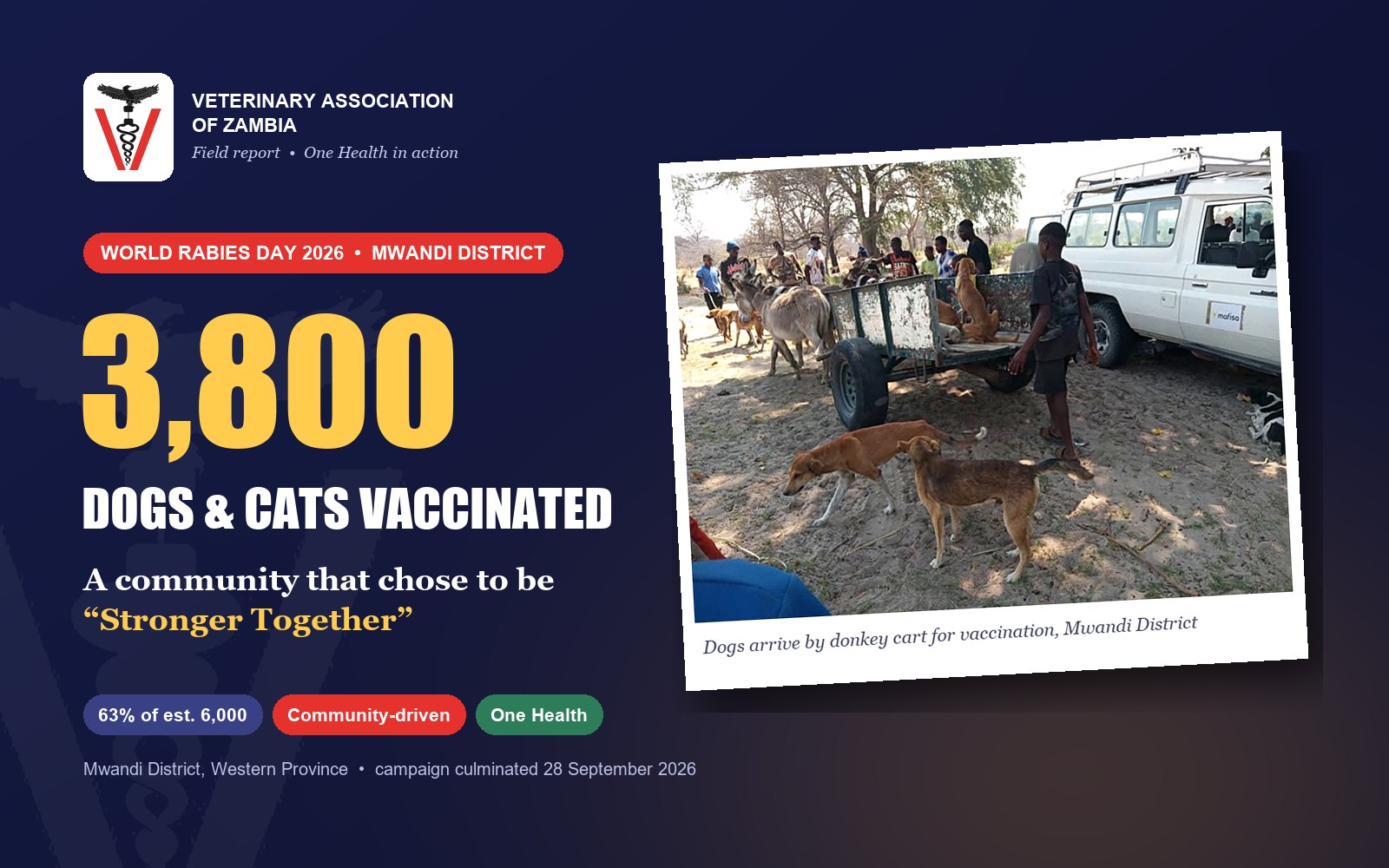
The campaign culminated on 28 September 2026, World Rabies Day, with approximately 3,800 dogs and cats vaccinated against rabies across the district. It was made possible by a generous donation of US$8,000 from a well-wisher. The donation shows how an individual contribution, combined with coordinated institutional and community action, can produce real public and animal health outcomes.
Built on partnership
The success rested on extensive planning and stakeholder engagement. Key partners were UCZ Mwandi Mission General Hospital; the community radio station run by the Mafisa project; Mwandi Town Council; Mwandi Livestock Cooperative; Showgrounds Veterinary Clinic; the Veterinary Association of Zambia; Lusaka Animal Welfare; and the Ministry of Fisheries and Livestock, which led implementation of the vaccination. Each contributed to different parts of planning, mobilisation, logistics, technical support and delivery.
How Mwandi did it
The message went where people already gather
Community engagement was central. High coverage needs communities to know when, where and why to bring their animals, so the campaign opened with an intensive awareness and mobilisation drive that went well beyond conventional veterinary channels.
This approach treated existing community structures as essential components of an effective rabies communication system.
Technology for accountability
Dr Rich Chazya of the Zambia National Public Health Institute (ZNPHI) trained the vaccination teams on the WVS Rabies Tracker. The digital platform captured vaccination data in real time, giving the campaign a way to monitor progress and document activities as they happened.
“Rabies cannot be defeated by the veterinary sector acting alone.”Prof Chisoni Mumba, University of Zambia
One Health: who brought what
Stronger
Together
against rabies
Veterinary services, the human health sector, local government, traditional leaders, community organisations, animal welfare groups, livestock organisations, religious institutions and communities worked together. That collaboration is the One Health approach effective rabies prevention and elimination demand. Human and animal health are inseparable in rabies control: preventing infection in dogs directly protects people.
Financial resources matter, but Mwandi shows how much further they go when institutions and communities pursue a common objective. The 3,800 animals vaccinated by World Rabies Day are a vaccination milestone and a demonstration of what coordinated One Health action can achieve.
The lesson from Mwandi is simple: no single institution can eliminate rabies alone. When communities, government, traditional leadership, health professionals, veterinary services, civil society and partners work together, the goal of ending human deaths from dog-mediated rabies becomes increasingly achievable.
Stronger Together. Stronger against rabies.
What Mwandi means for VAZ members
The Association followed the Mwandi campaign closely and supported its activities. It is one of the most successful community-driven rabies campaigns Zambia has seen. Three practices are worth copying in any district:
- Go to the leaders first. Brief traditional leaders before the first dog is vaccinated.
- Use the gatherings that already exist. Churches, burials and community radio reach households that notices never do.
- Count in real time. A digital tracker turns a campaign into evidence and keeps teams accountable.
The partners behind Mwandi
Select a logo to visit that organisation’s website or official page.
 Ministry of Fisheries and LivestockLed implementation of the vaccinationVisit website →
 Zambia National Public Health InstituteTrained teams on the WVS Rabies TrackerVisit website →
 Mwandi Town CouncilLocal government partnerVisit website →UCZ Mwandi Mission General HospitalHuman health partnerVisit website →
 MafisaRuns the community radio stationVisit website →
 Veterinary Association of ZambiaFollowed and supported the campaignVisit website →Lusaka Animal Welfare SocietyAnimal welfare partnerFacebook page →
Also referenced in the report
 Worldwide Veterinary ServiceMaker of the WVS Rabies TrackerVisit website →
 University of ZambiaSchool of Veterinary Medicine, the author's homeVisit website →
 Global Alliance for Rabies ControlCoordinates World Rabies DayVisit website →
About the author. Prof Chisoni Mumba is an associate professor of animal health economics in the School of Veterinary Medicine at the University of Zambia. His role in the Mwandi campaign covered planning, resource mobilisation and logistical support for cost-effective rabies vaccination in rural communities.
*Coverage (63%), the 70% target in animals (≈4,200), the remaining gap (≈400) and donated funds per animal (US$8,000 ÷ 3,800) are VAZ calculations from the figures in Prof Mumba’s report. The dog and cat population of 6,000 is an estimate.